According to NOAA’s Storm Prediction Center, the nation experiences more than one thousand tornado touchdowns each year with the highest frequency during the normal season between March and July. Though a tornado can happen almost anywhere, geographically the area of the nation most susceptible to these touchdowns includes Florida, and a stretch of the central and southern plains from South Dakota to Texas.
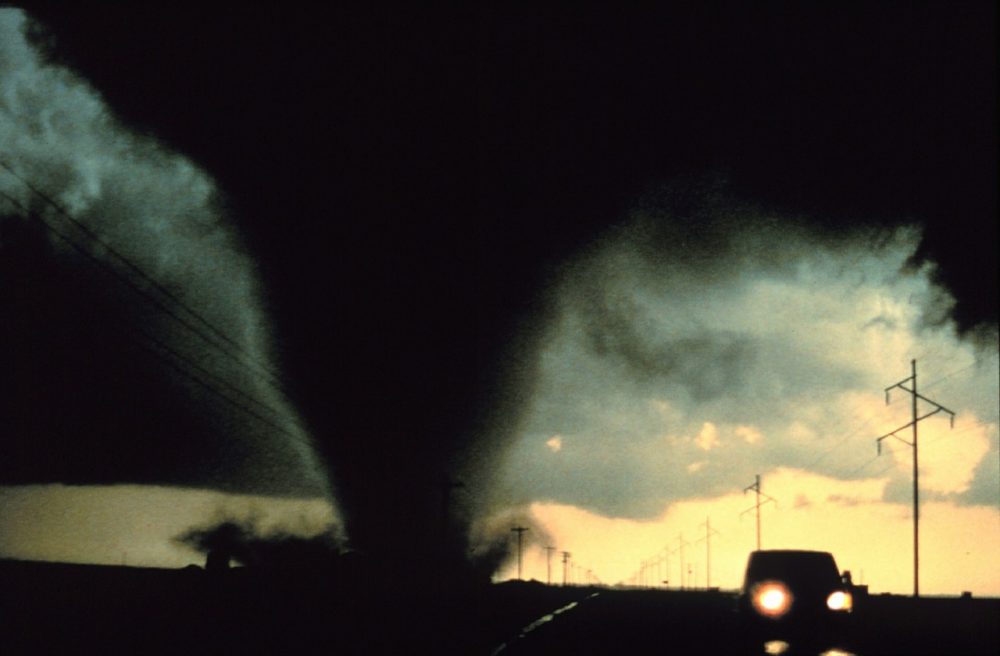
I’ve always lived in Texas, and tornadoes are just a normal thing to deal with here. I’ve never lived in an area where basements were common, so that has never been an option. When the weather starts to look favorable for a tornado, it’s time to really get prepared, find that safe place in the house, and have supplies and such available near us. Read on for some great tornado safety tips for the family!
Tornado Formation
Tornadoes form through a series of weather patterns. As a severe thunderstorm builds, high upper atmosphere winds cross opposing ground winds creating a horizontal rotating column of air. As the column builds in intensity and speed, rising air within the thunderstorm causes the column to shift to a vertical position. Now vertical, this column of air can stretch down from the cloud to a body of water, termed a ‘water spout’, or on land called a tornado. Typically, the sky appears thick with dark clouds that seem to be rotating.
A tornado can take many different shapes and sizes and its severity depends on the speed of rotation. According to NOAA (Nssl.noaa.gov) 69% of tornadoes are classified as weak, lasting on average less than ten minutes and have a wind speed of less than 110 mph. Strong tornadoes account for 29% and last 20 minutes or longer. They can reach speeds of 110-205 mph. Only 2% of tornadoes are classified as violent, reaching speeds of more than 210 mph and possibly lasting more than one hour.
Tornado Terminology
Some common tornado terminology used by FEMA (Fema.gov) when advising the community of impending tornado activity includes Storm Watch, Tornado Watch, and Tornado Warning.
A Storm Watch is the least severe and is issued when hazardous weather is possible, including heavy accumulations of precipitation, hail, strong winds, and lightning.
A Tornado Watch is issued when conditions exist which are favorable for the development of tornadoes and severe thunderstorms in or near the watch area.
Conversely, a Tornado Warning is issued when a funnel cloud or tornado has been confirmed in the vicinity, either by radar or field observation.
Tornado Preparedness
Before the storm season approaches it is imperative for families to prepare for tornado response planning.
The first step in preparation is to make a plan. Decide how you and your family will respond during a tornado. Will you stay in the house or will you go somewhere more safe (especially important if you live in a mobile home or in an upper-story apartment)? What provisions will you need? Contact your local Office of Emergency Management (OEM) for more information.
The second step in tornado response planning is to designate a contact person for everyone in the family. This might be a member of the household or it may even be a good friend or neighbor. The import thing to remember when deciding on a contact person is to choose one that will not also be affected. Family or friends outside the immediate area are best.
The third step in tornado response planning is to gather supplies to make a 72-hour kit. A basic 72-hour kit should include the following items:
Water (one gallon per person per day for three days)
Food (at least a three-day supply of non-perishable food)
Battery-powered or hand crank weather radio
Flashlight
First Aid kit
Whistle to signal for help
Planning early means items can be purchased over time and placed in a weather-resistant container such as a plastic tub or storage container.
You might also consider adding bike helmets for each person, car seats for young children, a mattress to place over you, and shoes for each person to wear. If your home gets destroyed or is close to any structure that has been flung about, it may be important to have these items for your safety.
The last step in tornado response planning is making small changes to your home or office. These changes might include inspection of a tornado shelter located in proximity to the house or basement to ensure doors can be opened safely, and that it is structurally stable enough to protect the family. Securing items such as hot water heaters, piping, furnaces, and shelving will provide extra protection against falling items. In addition, if it is possible, learn from a trained professional how to turn off utilities to the home in an emergency. However, remember never to turn them back on unless by a qualified person.
You never know where you might be when a tornado strikes, so don’t just think about your home. At the office, it is important to review the severe weather policies or procedures and make any necessary changes.
Before the next tornado is spotted in your area, be sure to review these tornado safety tips to make sure your family is ready!

