Study skills are important to students at all levels, so I was glad to be able to put the Victus Study Skills System to use with my kids. Their system is meant to be used in 5 one-hour sessions to teach children and adults how to effectively study by truly incorporating the taught skills into daily life. It basically teaches users to set themselves up for success by using specific habits and goal setting.

Victus Study Skills System
All levels use the same Teacher Edition, so I made use of that with each of my kids. We received a copy of Levels 1-4 and the Student Planner. My 6 year old used the Level 1: Primary (K-2/3) set. My 9 year old used the Level 2: Elementary (2/3-4/5). My 12 year old used Level 3 (5/6-10/11). The numbers in parentheses relate to grade levels.
Each of the levels follow the same format for the lessons, of which there are 10. They each include a section in the Teacher Edition to talk about the Purpose of the lesson and the Preparation needed for it, as well as at least one Procedure to be completed to reinforce the lesson.
The 10 lessons are meant to be taught exactly as written, so they need to be done sequentially. For each level, students go over the three Cornerstones of the program: “Where am I now?”, “Where do I want to be?”, and “How do I get there?”
The individual lessons cover study habits, learning strengths, mission and goal setting, time management, organization and study environment, a method for improving reading comprehension and retention called PQRST, listening, note taking, text taking, and a review. In the Teacher Edition, there are also extension exercises, sample course plans, and smaller copies of the student pages with the correct answers filled in. This is true of the Teacher Supplements as well, as the student pages for the different levels are all different, even though they all cover the same information.
Each student will need their own workbook for their own level. This could easily be done in a classroom setting, but we were able to adapt it for our homeschool with ease.
For us, I would teach the lesson to all three of my kids at the same time from the Teacher Edition. Then, during the day as we had some time, I worked on the Workbook pages with my boys individually. I could have done it all together, but my kids kind of scatter to finish schoolwork, so it’s easier to just get one at a time.

How We Used the Victus Study Skills System
For Level 1, we used the Primary Grades Student Workbook and the Teacher Supplement. These are small paper booklet of about 11 pages in length. The lessons are brief and are meant to be completed over five days. My son enjoyed having little check boxes to answer questions and blanks to fill in with his answers since his regular school doesn’t have a lot of that. He enjoyed the course, and I hope he picked up some good ideas so when his coursework in our homeschool amps up a bit in a year or two, he will be able to face it more easily.
In the Teacher Supplement, there are several suggested activities that are age-appropriate to reinforce what was learned. For example, using puppets to role play, doing an art activity with finger paints, class discussion questions, playing “I Spy”, and more. These activities are optional, and several of them are geared more toward the classroom setting. I think this would be a great co-op course to complete over 5 weeks with this age range.

For Level 2, there is the Elementary Student Workbook (spiral-bound and 56 pages) and a small Teacher Supplement booklet (23 pages). My 3rd grader worked through this program with me. Our favorite take-away from this one was setting missions, goals, objectives, and action plans. This is something we had never sat down and really talked about, so Heath was intrigued.
I love that it encouraged prioritizing things in life, such as family, friends, religion, playtime, sports, and other things. One of the exercises had him prioritize those in order of importance and then go in and honestly estimate the priority placed on them in real life based on how much actual time is spent doing each one. That was kind of eye opening for us both!
He enjoyed the many checklists and questionnaires throughout the lessons. It gave him a way to take a step back and assess where is is now and set goals for getting to where he wants to be in many aspects of his life. I was also grateful for the note taking section, because he has only been explicitly taught to take notes by me on a few occasions, so seeing new strategies and outlines to recreate for himself was a great way to get him to think of ways to be more independent with his learning.
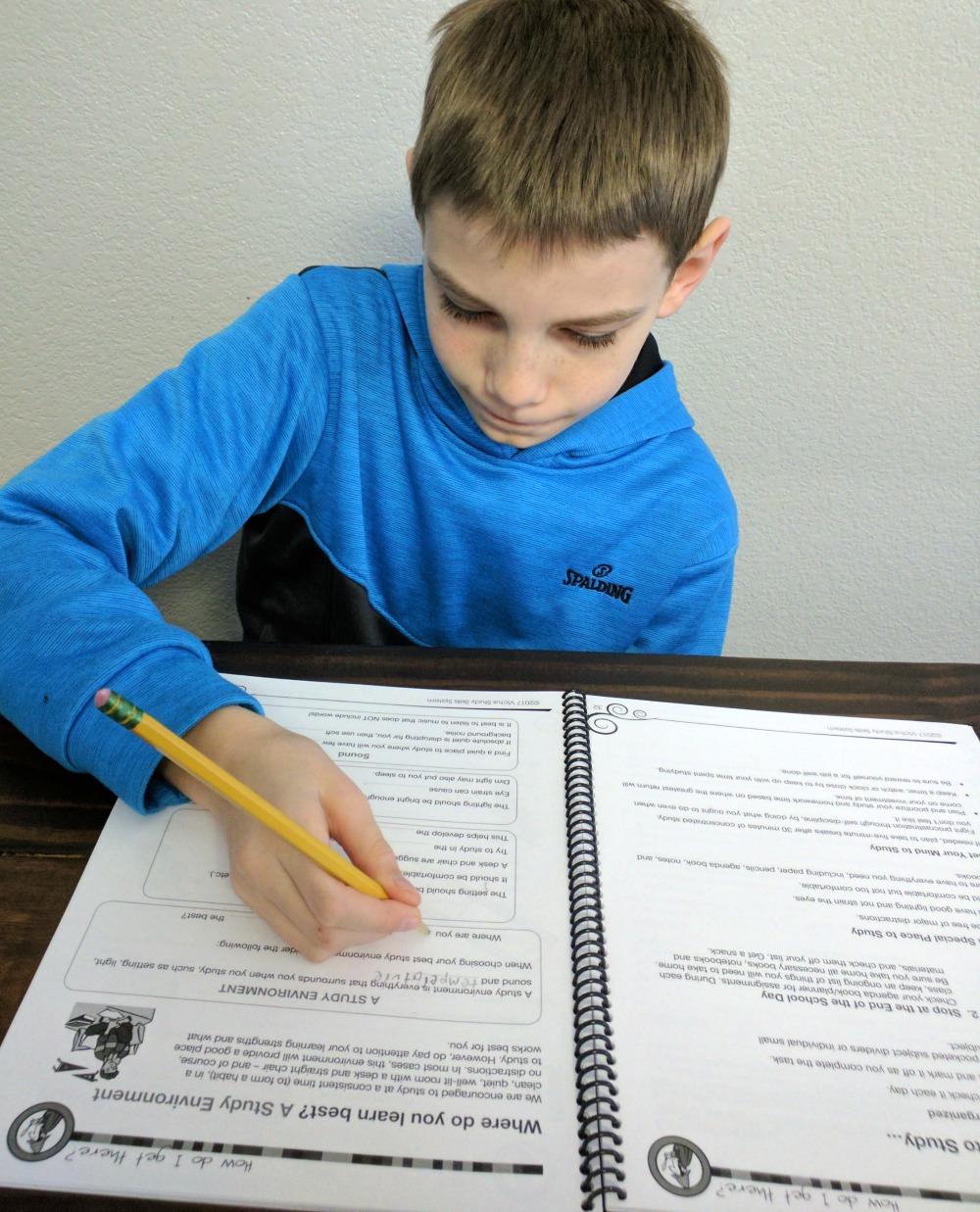
Level 3 uses the Student Workbook and the Teacher Edition. Both of these are spiral-bound, with the student workbook being 64 pages and the teacher edition at 82 pages. This level really starts having the students take personal responsibility for their time management and goal setting. They are spoken to as capable and intelligent students who should expect a great deal from themselves.
My 6th grader used this level. He does not like having to write a lot for school assignments, so the brief fill in the blank and checklist style of most of the work in the Workbook was appealing to him.
At first, he didn’t like the goal setting portion of the course, but he eventually came around and we came up with some attainable goals, with action plans to match. The workbook had him doing this in academic subjects, extracurricular activities, physical fitness and health, and family/personal goals. He learned how to write the goal and objective so he is able to work toward something and easily tell if he has succeeded!
They teach the SMART method for goals (specific, measurable, achievable, realistic, time-bound), which I’ve used before in my own goal planning, so I was happy to see it in this program.
In addition to the products we were able to use, we also received the Level 4 Student Workbook, which is intended for 10th or 11th graders all the way through adult. It is labeled as a College level. While we didn’t use this one, I did look through it. The lessons in these are the same, but go more in-depth. There are specific sections like “Time Management in College” and some discussion using a sample college syllabus, for example.
I remember taking a study skills workshop in college as a freshman, and this information is much more thorough than that, which I love! It goes well beyond how to take notes and highlight things effectively. It talks about how to read efficiently, how to become an active learner instead of a passive one, givers checklists for essays and writing assignments, and more.
We also received a Student Planner, which goes right alongside the lessons taught in the Victus Study Skills System. It has a place for the student to write their mission statement, a place to note some values that are important to them and their definitions, a spot for goals and their goal statements, and gives tips on prioritizing a daily to-do list. It also goes over objectives and action plans.
After that, it includes weekly calendars on pages 12-115. Each week takes 2 pages, so you just open it up to see the information for the whole week, grid planner style. There are 6 columns across and the rows are for the days of the week, including smaller sections for Saturday and Sunday as well. There are inspirational quotes on each left page, and “odd but true” facts on each right page in the weekly planner pages. There are spots for goals and objectives and the headers for each column are left blank for your student (or yourself) to label as is appropriate for your scheduling needs. On the very right margin, there is a spot for a weekly to-do list, which should be prioritized.
At the back of the Student Planner, there are a few pages for notes, a page for planning out some life goals (such as 2019-2020 – Complete 9th grade), and a Grade Log with room for 8 different subjects.
Final Thoughts
I liked that the lessons were short and sweet. They shouldn’t take more than an hour, and the lessons for younger students can take even less, depending on how many extra activities you throw in. Keep in mind that the more reinforcement activities you do, the higher their retention of that information!
I liked teaching this to them, and I found myself encouraging them to do small things here and there as teachable moments popped up in our regular life. For example, I was reminded of something we learned about when my oldest son was using his planner and made a suggestion on how to tweak it a bit to be more efficient, and he immediately took that suggestion and put it to use. It was easy to implement most of what we learned into some existing habits and systems we already had in place.
I like that this is a brief course. It could be added to a high school level life-skills course, or incorporated into a test-prep course as well. There are many valuable, practical lessons in the pages of these books. It’s a fine addition to any level so that you can give your students the tools they need to succeed in school, but also in life!
See how other families implemented the Victus Study Skills System into their homeschool by clicking the banner below.